Golf course homes look stunning in photos. A fairway view at sunrise, mountains in the background, a pool that reflects the green. I understand the pull completely. But I have closed enough of these transactions to know exactly where the surprises show up, and they almost always show up after the buyer has already fallen in love with the view. The five questions below are the ones I walk every golf-community buyer through before we write an offer. Ask them early and you will make a much better decision.

A fairway-facing home in the Coachella Valley looks spectacular in listing photos. The questions behind the photo determine whether it holds up as an investment.
Question 01What Are the HOA Fees, and What Do They Actually Cover?
This is where most buyers get their first real surprise. Golf course communities in the Coachella Valley typically carry two separate fee structures: a standard HOA fee for community maintenance, and a separate club or golf membership fee. They are not always the same line item and they do not always come in the same bill.
The HOA fee handles things like landscaping the common areas, community security, exterior maintenance standards, and in some communities, basic amenities like a fitness center or community pool. That fee alone can run anywhere from $400 to over $1,500 per month depending on the community. At PGA West, for example, HOA fees vary significantly by sub-association and location within the development. At Bighorn or Tradition, the numbers are substantially higher and reflect the level of service those clubs maintain.
The golf membership is a completely separate question. Some communities require a mandatory golf membership as a condition of ownership. Others offer membership as optional but price homes on the assumption that most owners join. Equity memberships, where you pay a large initiation fee that is theoretically refundable when you sell, are common in premium communities. That initiation can run from $30,000 to well over $100,000 at the upper end of the market.
Before you get attached to any property, get the full fee schedule in writing: the HOA dues, any special assessment history, the membership initiation fee if applicable, and the annual or monthly dues for club access. Add those numbers together and make sure the total fits your budget comfortably, not just barely.
Question 02How Close Is the Home to the Cart Path, and Which Direction Does Play Run?
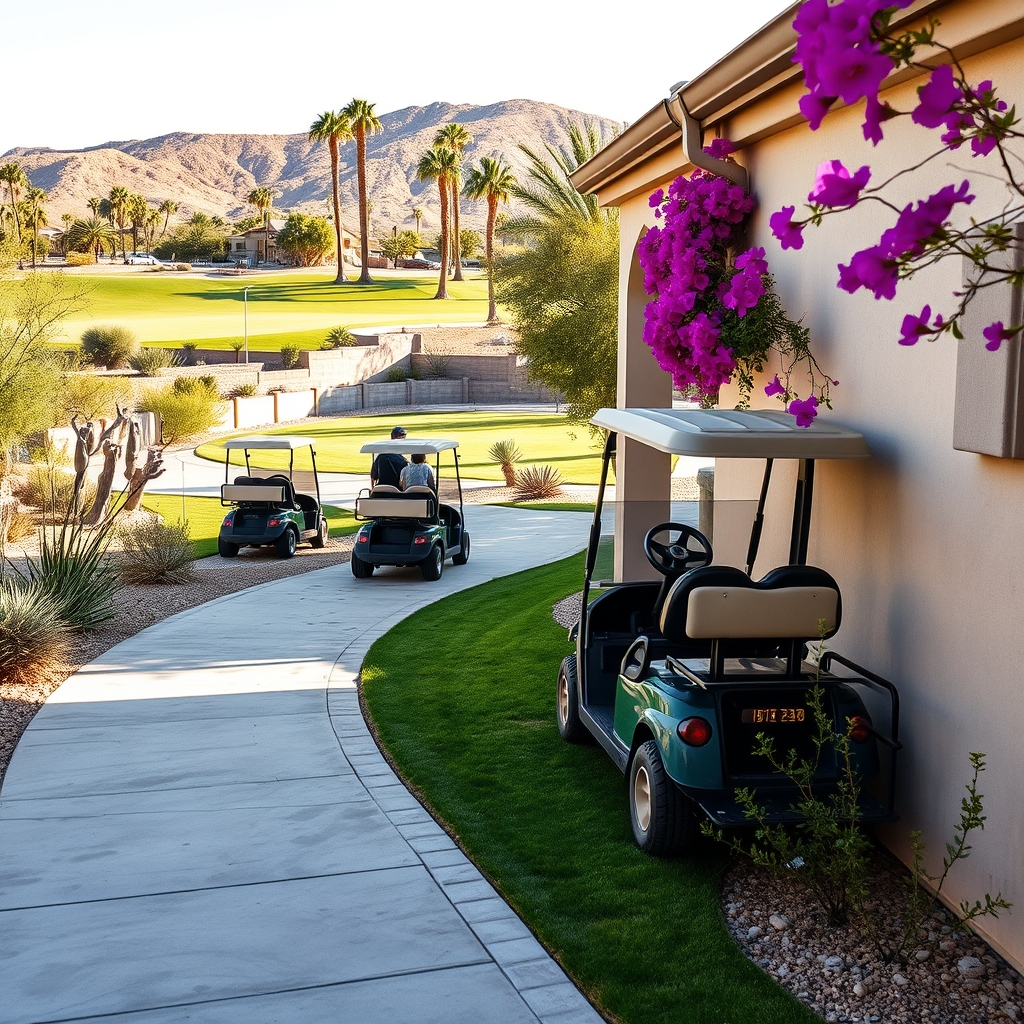
Cart paths within feet of a backyard wall are common in golf communities. Morning rounds start early, and the direction of play determines how much activity passes your patio.
This question sounds minor until you experience it firsthand. Golf cart traffic on a path ten feet from your back patio starts at first light on weekends and tournament days. The sound of carts, conversation between players, and the occasional ball striking a wall or fence is not the peaceful backdrop most buyers imagine when they picture living on a course.
The specific location matters enormously. A home set back 60 feet from the cart path with a wall and mature landscaping between them is a completely different experience from one where the path runs immediately adjacent to the property line. Similarly, whether the play runs toward your home or away from it affects both noise levels and the stray ball risk to your windows, vehicles, and anyone using the yard.
Ask for the course layout map and identify exactly which hole or holes border the property. Visit the home twice: once on a weekday morning and once on a weekend. Walk the backyard and patio while play is active. If the seller or listing agent resists scheduling those visits, treat that as information worth noting.
“The fairway view is what sells the home in photos. The cart path, the early tee times, and the HOA fee are what you actually live with every day.”
What Is the Course Maintenance Schedule, and Who Controls It?
Golf courses require serious maintenance. Mowing the greens and fairways happens before sunrise. Aeration, which involves punching holes across the entire course surface and top-dressing with sand, takes the course out of premium condition for weeks at a time and generates noise, dust, and equipment traffic that you will notice from your backyard. Chemical applications for turf management follow a schedule that is rarely shared proactively with homeowners.
The important question here is who controls the course. Some golf communities are member-owned, meaning the homeowners who hold club memberships have a collective voice in how the club is run, including maintenance standards, fee increases, and course conditions. Others are owned and operated by a separate management company or resort entity that makes those decisions independently, and the homeowners have no formal input.
If the course is privately owned by a resort or management group, ask about the lease or operating agreement. A course that closes, converts to a different use, or is sold to a developer would affect both your daily experience and your property value directly. This is not a hypothetical risk in the Coachella Valley. Several course-adjacent neighborhoods have faced exactly this situation in the past decade.
Question 04Is Golf Membership Mandatory, and What Happens If You Do Not Play?
Some of the valley’s most desirable golf communities have mandatory membership requirements built into the CC&Rs. That means buying the home legally requires you to purchase and maintain a golf club membership, regardless of whether you ever set foot on the course.
For buyers who golf regularly, this is a feature. For buyers who want the view but do not play, or who play occasionally elsewhere, it is a recurring cost with no corresponding benefit. If you own a vacation home in the community and rent it out during peak season, the question of how membership transfers to renters or guests is another layer worth clarifying before close.
Some communities offer social memberships at a lower fee tier that provides access to the clubhouse, dining, and amenities without full golf privileges. If that option exists and you are not a regular golfer, it may represent meaningful annual savings. Ask specifically whether a social or non-golf membership is available and what it includes.
Question 05What Does the Resale History for Golf-Front Homes in This Community Look Like?
Golf-front homes do not automatically appreciate faster than non-golf-front homes in the same community. In some markets and some specific communities, the fairway view commands a consistent premium and resale is straightforward. In others, the pool of buyers willing to pay for that specific position is smaller than sellers expect, and days on market are longer.
The premium you pay for a fairway view on the way in should be supported by actual transaction data from the community, not the general assumption that golf-front is always worth more. Pull the sales history for similar square footage in the same community and compare homes that back the course to homes that do not. The spread will tell you what the market actually thinks of the location, which is the only opinion that matters at resale.
Also ask whether the community has faced any course-related challenges in recent years: ownership changes, fee increases, temporary closures, or membership disputes. Communities where course management has been stable tend to show more consistent resale performance than those with operational uncertainty in the background.
More Questions Buyers Ask
Are golf course homes harder to insure in the desert?
Not typically harder to insure, but golf-adjacent homes can face specific exclusions or higher premiums for glass breakage from errant balls. Some insurers treat golf course adjacency as a higher risk for that specific coverage. Ask your insurer directly before close and confirm whether the policy covers ball damage to windows, vehicles, or personal property in the outdoor area.
Can I fence off or screen my backyard from the course?
Almost certainly not without HOA approval, and in many golf communities the CC&Rs restrict or prohibit fencing on the course-facing side entirely. The intent is to preserve sight lines and the aesthetic of the community from the course. If privacy is a priority for you, ask about what screening or landscaping is permitted before you fall in love with a specific lot.
Which Coachella Valley golf communities have the strongest resale track records?
Communities with member-owned clubs and stable, long-established governance tend to show the most consistent resale performance. PGA West, The Citrus Club, and Andalusia have each maintained active markets over time. Indian Wells and Bighorn perform well at the ultra-luxury end. The track record of any specific community is best evaluated by pulling actual sales data rather than relying on reputation alone.
Do HOA fees ever go down?
Rarely. HOA fees in golf communities tend to increase over time as maintenance costs rise and as older infrastructure requires replacement. Before buying, review the HOA’s reserve fund study if one is available. A community with a well-funded reserve is less likely to issue special assessments; one with an underfunded reserve carries the risk of a large one-time charge to cover deferred maintenance.